
Flying From Luton This Winter? New Routes, Travel Tips and Airport Drop-Off Advice

Flying from London Luton Airport this winter? Whether you are heading away for winter sun, a city break, a family visit or the Christmas holidays, planning how you will get to the airport is just as important as booking your flight.
Luton Airport is a popular choice for passengers across Hemel Hempstead, Berkhamsted, Tring, Leighton Buzzard and the surrounding areas. With early-morning departures, busy weekends, changing weather and extra traffic on the roads, arranging your airport transport early can help your journey begin smoothly.
TravelSkyline provides reliable Luton Airport taxi and transfer services for passengers who want a comfortable, pre-booked journey to the terminal.
What’s New at Luton Airport This Winter?
The winter flying timetable begins towards the end of October, bringing more choice for travellers looking for European breaks and overseas travel.
New and updated services scheduled for the winter season include:
- Málaga flights from 25 October 2026
- Granada flights from 27 October 2026
- Asturias flights from 27 October 2026
These additional destinations give passengers more options for holidays, visiting family or enjoying a late-autumn getaway. Málaga remains a popular choice for winter sun, while Granada and Asturias offer direct access to two very different parts of Spain. airportstransfer
However, new routes and winter timetables often mean early departures, late returns and higher demand for transport to the airport. Before travel day, always check your airline confirmation carefully, including your departure airport, flight number, check-in deadline and baggage allowance.
When Is Luton Airport Likely to Be Busy?
Luton Airport can be particularly busy during the winter travel period. Passenger demand often increases around weekends, school holidays, festive travel dates and early-morning flight schedules.
You may want to allow extra time when travelling during:
- Friday afternoons and evenings
- Saturday and Sunday mornings
- Early-morning flight departures
- School holidays and half-term breaks
- The Christmas and New Year period
- Long weekends and bank holidays
- Sunday evenings, when many travellers return from short breaks
- Poor-weather periods, including fog, ice, rain or snow
The airport journey does not start at check-in. It starts when you leave home. Traffic around the M1, busy local roads, weather conditions and airport access routes can all affect how long it takes to reach the terminal.
For this reason, leaving transport arrangements until the last minute can create unnecessary pressure. A confirmed airport drop-off booking gives you a planned collection time and one less thing to organise on the day.
How Early Should You Leave for Luton Airport?
There is no single answer because your ideal departure time depends on several factors:
- Your home or pickup location
- Your airline and destination
- Whether you have checked luggage
- Your flight departure time
- Whether you are travelling during a busy weekend or school holiday
- The expected weather and road conditions
- Whether you are travelling with children, extra luggage or a larger group
Start by checking your airline’s current arrival-time guidance. Then work backwards from your intended airport arrival time, adding realistic time for the drive to Luton Airport and a sensible buffer for traffic or delays.
For early flights, it is especially important to arrange travel in advance. Public-transport connections may be limited at certain times, while last-minute taxi availability can be less certain during busy periods.
A pre-booked Luton Airport transfer allows you to organise the journey around your flight schedule rather than hoping transport will be available when you need it.
Why Book Your Luton Airport Drop-Off Early?
Booking airport transport early is a simple way to make your travel day more predictable.
1. Secure your preferred pickup time
Early-morning flights often require a very early collection. Booking ahead means you can arrange a pickup time that fits your flight and allows suitable time for the journey.
2. Avoid last-minute transport stress
Searching for a taxi the night before a flight, particularly at weekends or during holiday periods, can add avoidable pressure. Pre-booking means your airport transport is already part of your travel plan.
3. Travel comfortably with luggage
Getting to the airport with suitcases, hand luggage, children’s items or winter clothing can be difficult on public transport. A private airport drop-off is a more direct and convenient option from your home, office or local address.
4. Reduce parking worries
Airport parking can involve availability concerns, long walks, shuttle buses and extra time at the beginning and end of a journey. An airport drop-off means you can be taken directly to the terminal area without needing to manage parking arrangements.
5. Plan for winter roads and weather
Winter weather can make road journeys less predictable. Rain, fog, ice and darker mornings can affect traffic flow, so building time into your journey is a sensible precaution.
Winter Travel Checklist for Luton Airport
Before you leave home, take a few minutes to check the essentials:
- Confirm your flight number, airline and departure time
- Complete online check-in if your airline offers it
- Check baggage rules, including cabin-bag size and liquids restrictions
- Keep your passport, travel documents and boarding pass easy to access
- Check the weather at home and at your destination
- Charge your phone and keep essential booking details available
- Allow extra time for traffic, roadworks or poor weather
- Confirm your airport drop-off pickup time and location
- Keep your transfer provider’s contact details saved on your phone
- Avoid leaving airport transport until the night before travel
A little planning can make a significant difference, particularly when travelling during busy seasonal periods.
Travelling to Luton Airport From Hemel Hempstead and Nearby Areas
For passengers travelling from Hemel Hempstead, Berkhamsted, Tring, Leighton Buzzard and nearby towns, Luton Airport can be a convenient departure point—but only if the journey to the airport is properly planned.
TravelSkyline offers airport transfers designed around your flight time and pickup requirements. Whether you are travelling alone, with family, for business or with several cases, booking ahead gives you a confirmed plan for reaching the airport.
Visit the dedicated Luton Airport taxi page for more information about TravelSkyline’s Luton Airport transfer service.
Book Your Luton Airport Drop-Off Early
If you are flying from London Luton Airport this winter, do not leave your journey to the terminal until the last minute. Early booking helps you secure your preferred pickup time and gives you more confidence on travel day.
TravelSkyline provides dependable airport drop-off services for passengers travelling to Luton Airport from Hemel Hempstead and the surrounding area.
Book your airport drop-off early with TravelSkyline
Whether you are catching an early flight, travelling during a busy weekend or heading away over the festive period, pre-booking your airport transfer can help your trip start in the right way.
Frequently Asked Questions
Which new routes are available from Luton Airport this winter?
The late-October 2026 winter timetable includes Málaga from 25 October, plus Granada and Asturias from 27 October. Always confirm the latest schedule directly with your airline before booking. airportstransfer
How early should I arrive at Luton Airport?
Arrival recommendations vary by airline, destination, baggage requirements and time of travel. Check your airline’s guidance and allow extra time during busy periods, early flights and winter weather.
Is it better to pre-book a Luton Airport taxi?
Pre-booking gives you a confirmed pickup plan and can be particularly useful for early departures, weekends, school holidays and the Christmas travel period.
Can I book a Luton Airport transfer from Hemel Hempstead?
Yes. TravelSkyline provides Luton Airport transfers from Hemel Hempstead and surrounding areas.
Why should I book airport transport early in winter?
Winter traffic, reduced daylight, busy travel dates and poor weather can all make road journeys less predictable. Booking early helps ensure that your airport transport is arranged before the day of your flight.
3 Backup Plans When Trains to Heathrow Suddenly Stop

Your train to Heathrow is cancelled. The departure board keeps changing, other passengers are following conflicting advice, and your airline’s bag-drop deadline is getting closer.
This is exactly when travellers need a decision plan—not another ten minutes of hopeful waiting.
A signalling-system fault disrupted services between London Paddington and Heathrow Airport or Reading on 16 September 2026. National Rail recorded the incident at 09:37 and said it was cleared at 12:40; Heathrow Express and Great Western Railway services were affected.[1] Earlier in the month, a trackside fire caused an electricity-supply failure in the Paddington area, disrupting services towards Heathrow and stopping Heathrow Express during the incident.[2]
Both incidents are now resolved. The lesson is not that Heathrow’s trains are permanently unreliable. It is that a journey with a fixed flight deadline needs a backup route and a clear point at which you stop waiting.
Advice checked: 17 September 2026 at 08:43 BST. Transport conditions can change quickly. Recheck National Rail, Transport for London and your airline immediately before travelling.
Heathrow train disruption: the three-part plan
| Stage | What to do | The question to answer |
|---|---|---|
| 1. Check | Verify the live incident and identify the affected service | Is the whole route disrupted, or only one train, branch or operator? |
| 2. Switch | Compare the Piccadilly line, coach or rail-air alternatives | Which working route protects the most time from where I am now? |
| 3. Transfer | Use a licensed pre-booked road transfer at your cutoff time | When must I stop waiting to protect the flight deadline? |
The best choice depends on your starting point, terminal, luggage, mobility requirements, airline deadline and the exact disruption. There is no single backup route that works for every passenger.
First, calculate your real airport deadline
Before comparing routes, establish how much time you actually have.
Heathrow’s general guidance is to arrive three hours before an international flight and two hours before a domestic or European flight.[3] Your airline may have its own check-in, bag-drop and boarding deadlines, so check the booking confirmation or airline app rather than relying on a general rule.
Work backwards from the earliest deadline that applies to you:
- Note the bag-drop or check-in closing time.
- Allow time to enter the correct terminal and reach the airline’s desks.
- Add the airport arrival margin recommended for your flight.
- Add realistic journey time from your present location.
- Add a disruption buffer for waiting, changing modes and carrying luggage.
The result is your switch time: the latest point at which you can continue waiting for the original route without putting the flight at unreasonable risk.
Do not choose one universal figure, such as “wait 20 minutes.” A passenger already at Paddington with hand luggage has a different decision from a family leaving Hertfordshire with checked bags.
Backup plan 1: Verify what has actually stopped
A cancelled train does not always mean every Heathrow rail option has failed.
Heathrow has three direct rail or Underground choices from central London: Heathrow Express, the Elizabeth line and the Piccadilly line.[6] An incident might affect one operator, the wider Paddington corridor, a terminal branch or only a small group of services.
Check:
- the live National Rail disruption notice;
- TfL’s current Elizabeth and Piccadilly line status;
- the departure station and platform information;
- whether your terminal branch is operating;
- whether the notice provides ticket acceptance on another operator; and
- whether the incident has an estimated clearing time.
TfL Go provides a live map, line and station disruption information, live arrivals and journey planning that adapts to closures.[4] Use it alongside National Rail rather than relying on a saved screenshot, an old social-media post or another passenger’s route.
Do not assume ticket acceptance
During some incidents, operators allow affected rail tickets on alternative Underground, bus or rail services. That does not mean acceptance is automatic every time.
Read the current disruption notice. If it does not clearly name your ticket type and alternative service, ask station staff or the operator before travelling. Contactless and Oyster journeys can also be treated differently from National Rail paper tickets or e-tickets.
When plan 1 is enough
Stay with the rail network if:
- a working service still reaches your terminal with a comfortable margin;
- the delay estimate is credible and comfortably inside your switch time;
- the problem affects only a different terminal branch; or
- staff confirm a simple reroute with enough remaining time.
Move to plan 2 when the live options no longer protect your airport buffer.
Backup plan 2: Switch to the Tube, coach or a rail-air connection
If the Paddington rail corridor is disrupted but London Underground is operating, the Piccadilly line may be the most useful public-transport alternative.
TfL says the Piccadilly line serves Heathrow Terminals 2 & 3, Terminal 4 and Terminal 5. The journey between Heathrow and central London is approximately 50 minutes, before allowing for walking, waiting and interchange time.[5]
The important words are from where you are now. Travelling across London to reach a famous airport route may waste more time than using the nearest working connection.
Check the correct Heathrow branch
Before boarding:
- confirm the train’s destination;
- check that it serves your terminal;
- allow time to walk from the station to check-in;
- check step-free access if required; and
- remember that luggage can make an interchange slower than the journey planner’s ideal estimate.
Do not board simply because “Heathrow” appears on the line map. Check the live destination display and listen for service changes.
Consider coach and rail-air links outside central London
A central-London route is not always the best option for travellers coming from Hertfordshire, Bedfordshire, Buckinghamshire or farther west.
Heathrow lists rail-air bus links connecting the airport with locations including Feltham, Guildford, Reading, Watford Junction and Woking.[6] TfL also identifies a regular National Express connection between Heathrow and Victoria Coach Station.[5]
Depending on your location, a coach or bus link may avoid travelling into Paddington and then back out towards the airport.
Compare:
- the departure point and next available service;
- total journey time, not only the time on board;
- terminal served;
- luggage allowance and handling;
- accessibility;
- road congestion; and
- the time required to reach the coach or bus stop.
A coach that departs in 45 minutes is not automatically better than a slower Tube route leaving now. Use the full door-to-terminal estimate.
When to leave plan 2
Switch to plan 3 if:
- the next workable service leaves too little airport time;
- the suggested route requires several risky interchanges;
- you cannot confirm which terminal it serves;
- luggage or accessibility needs make the route impractical; or
- your switch time has arrived.
Backup plan 3: Use a licensed pre-booked road transfer
A road transfer can remove station changes and take you directly to the required terminal. It does not remove traffic, road incidents or airport congestion, so it should be treated as a planned contingency rather than a guarantee.
The advantage is control: you choose the pickup point, vehicle size and departure time before the remaining buffer disappears.
Use a licensed operator
TfL says private-hire vehicles, including minicabs, must be pre-booked through a TfL-licensed private-hire operator. Before the journey starts, the operator must provide booking confirmation containing at least the vehicle registration, the driver’s first name and the driver’s private-hire licence number. A driver photo should also be provided where the passenger can receive it.[7]
Before entering the vehicle:
- Match the registration number.
- Check the driver’s name and photograph where supplied.
- Confirm the pickup destination and terminal.
- Do not accept an unsolicited minicab offered on the street or at the station.
- Contact the operator if the arriving vehicle or driver does not match the booking.
A sticker alone is not proof that a private-hire vehicle is licensed. Use the booking confirmation and, if needed, TfL’s licence checker.[7]
What to tell the transfer operator
Provide:
- your exact pickup location;
- Heathrow terminal;
- flight departure time;
- airline check-in or bag-drop deadline;
- number of passengers;
- luggage quantity;
- child-seat, wheelchair or accessibility requirements; and
- a mobile number for updates.
Ask for a realistic collection estimate based on current road conditions. If the estimate no longer protects your flight deadline, contact the airline promptly and ask about the available options rather than relying on an impossible journey.
A practical Heathrow disruption checklist
Save this list before your next airport journey:
- Check the airline: Confirm the flight and the airline’s check-in, bag-drop and boarding deadlines.
- Check the incident: Use National Rail and TfL’s official live information.
- Identify the scope: Find out whether Heathrow Express, the Elizabeth line, the Piccadilly line or a terminal branch is affected.
- Set a switch time: Decide when waiting must stop.
- Compare full journeys: Include walking, interchange, luggage and terminal access.
- Read ticket-acceptance rules: Never assume they apply.
- Prepare a road option: Save the details of a licensed transfer provider.
- Verify the vehicle: Match the driver and registration before entering.
- Keep the airline informed: Use the airline app or contact centre if the deadline is no longer achievable.
Should you book a Heathrow airport transfer in advance?
If your flight has a fixed early check-in, you are travelling with several bags or passengers, or your rail itinerary relies on multiple connections, a pre-booked transfer may give you a simpler door-to-terminal plan.
Travel Skyline provides airport pickup and drop-off services from its service area in Hertfordshire, Bedfordshire and Buckinghamshire, with booking options for airport transfers.[8] Booking ahead allows the pickup point, vehicle and luggage requirements to be arranged before disruption creates last-minute demand.
Road journeys remain vulnerable to traffic. Leave a realistic margin, monitor the flight and do not treat any transport option as capable of guaranteeing an on-time arrival in every circumstance.
Book an airport drop-off or pickup with Travel Skyline or call 01442 241 111.
Frequently asked questions
What should I do first if my Heathrow Express train is cancelled?
Check the live National Rail notice and establish whether the Elizabeth line is operating. If the wider Paddington corridor is affected, compare the Piccadilly line, coach or a licensed road transfer. Do not assume every Heathrow service has stopped.
Does the Piccadilly line serve every Heathrow terminal?
The Piccadilly line serves Terminals 2 & 3, Terminal 4 and Terminal 5. Check the destination shown on the train and the live service status before boarding.[5]
How long does the Piccadilly line take to Heathrow?
TfL estimates approximately 50 minutes between central London and Heathrow. Add waiting, walking, interchange and terminal-access time.[5]
Will my rail ticket be accepted on the Tube or a bus?
Only rely on ticket acceptance when the current disruption notice or operator confirms it. Arrangements vary by incident, operator and ticket type.
When should I stop waiting for a delayed train?
Set a switch time by working backwards from the airline’s check-in, bag-drop or boarding deadline. Include the replacement journey, terminal access, security and a disruption buffer. There is no safe universal waiting time.
Is it safe to take a minicab offered outside a station?
Do not use an unsolicited private-hire vehicle. TfL says private-hire journeys must be booked through a licensed operator, which provides identifying details for the driver and vehicle.[7]
Can a taxi guarantee that I will catch my flight?
No. Road traffic, incidents and airport congestion can still cause delays. A pre-booked transfer gives you another planned route, but it cannot guarantee the result.
The key rule: do not wait without a deadline
When trains to Heathrow stop, the most expensive mistake may be continuing to wait after the journey has stopped protecting your flight.
Check what has actually failed. Compare the best working public-transport route from your location. Then switch to a licensed pre-booked transfer before—not after—your remaining buffer disappears.
And remember to book airport drop off and pickup early with Travel Skyline.
Sources
[1] https://www.nationalrail.co.uk/service-disruptions/southall-20260916 [2] https://www.nationalrail.co.uk/service-disruptions/southall-20260905 [3] https://www.heathrow.com/departures/checking-in [4] https://tfl.gov.uk/maps_/tfl-go?intcmp=hero-Plan+a+journey-Download+TfL+Go [5] https://tfl.gov.uk/travel-information/visiting-london/getting-to-london/london-airports?intcmp=6176 [6] https://www.heathrow.com/transport-and-directions/by-rail-or-train [7] https://tfl.gov.uk/modes/taxis-and-minicabs/what-to-expect-from-your-journey [8] https://travelskyline.co.uk/airport-transfers-info
Can passengers claim compensation for the NATS outage?
Research checked: 10 September 2026 at 08:36 BST
Passenger rights depend on the facts of each booking and disruption. This article is general information, not legal advice.
If your flight was cancelled or badly delayed after the UK air-traffic-control failure on 8 September 2026, you may have heard that compensation is unlikely. That is broadly the Civil Aviation Authority’s current position—but it does not mean your airline owes you nothing.
The important distinction is between fixed cash compensation and the airline’s separate duties to provide care, a refund or rerouting. Even when an incident falls outside the airline’s control, those practical passenger rights can still apply.
What happened during the NATS disruption?
NATS said a technical issue affected its flight-processing system on 8 September. It announced that the system issue had been resolved by 19:30 that evening, while warning that clearing the backlog and recovering airline and airport operations would take time.
On 9 September, NATS said its operations were stable and that it was working with airlines and airports on their recovery. It also said a full investigation would establish what happened and identify any further action needed.
The CAA reported that the technical problem led to delays and the cancellation of hundreds of flights arriving in and departing from the UK. It also recognised that the operational knock-on effects continued after the system itself was restored.
Passengers should therefore check the latest status directly with their operating airline rather than relying only on airport departure boards, social-media posts or earlier news reports.
Can passengers claim compensation for the NATS outage?
The CAA considers delays and cancellations caused directly by the NATS outage likely to be “extraordinary circumstances” under UK passenger-rights rules. It says the direct knock-on effects are also likely to fall into that category.[1]
That matters because airlines normally do not have to pay fixed UK261 compensation when they can show that disruption resulted from extraordinary circumstances outside their control. For passengers whose delay or cancellation was directly caused by this incident, fixed cash compensation is therefore unlikely.[1]
However, this is guidance rather than an automatic ruling on every claim. The CAA says each case is context- and fact-specific, and passengers remain free to make a claim or challenge an interpretation with which they disagree.[1]
A later problem caused by an airline’s own operations may require a separate assessment. Ask the airline to identify the specific cause of your disruption in writing if its explanation is unclear.
Compensation is not the same as care and assistance
Fixed compensation is a set payment that may be available for certain qualifying cancellations or delays. Care and assistance covers what the airline must reasonably provide while you are stranded or waiting.
The CAA says airlines must look after eligible passengers regardless of what caused a qualifying delay or cancellation.[2][3] Therefore, an airline may reasonably reject a fixed-compensation claim because of extraordinary circumstances while still owing the passenger meals, accommodation, rerouting or reimbursement of reasonable expenses.
What must an airline provide during a delay?
For flights covered by UK law, the right to care begins after:
- two hours for flights under 1,500 kilometres;
- three hours for flights between 1,500 and 3,500 kilometres; and
- four hours for flights over 3,500 kilometres.[3]
Once the relevant threshold is reached, the airline should provide:
- food and drink appropriate to the waiting time;
- a means of communication, usually two telephone calls or emails;
- accommodation if an overnight stay is necessary; and
- transport between the airport and that accommodation.[3]
The support must be proportionate. It does not normally cover alcohol, luxury meals or an unnecessarily expensive hotel.[2][3]
If a delay reaches at least five hours and you decide not to travel, the CAA says you can choose a refund for the flights you have not taken on that booking.[3]Do not accept this option if you still want the airline to transport you to your destination.
What are your options when a flight is cancelled?
If a cancellation is covered by UK passenger-rights law, the airline must offer a genuine choice between:
- A refund for the unused part of the ticket;
- Rerouting at the earliest opportunity; or
- Rerouting at a later date that suits you, subject to availability.[1][2]
If an alternative carrier can get you to the destination significantly sooner, the CAA says you may have the right to be placed on that service. Other suitable transport may also be relevant in some circumstances. Discuss the available options with the operating airline before buying an expensive replacement yourself.[2]
For a journey booked as one connecting itinerary, additional rights may apply if disruption causes a missed connection. Separate self-transfer bookings are treated differently, so check each booking carefully.[3]
What if the airline does not provide food, a hotel or rerouting?
If the airline cannot organise reasonable care, the CAA’s position is that passengers may make their own arrangements and claim those costs back later.[2][3]
- Ask the airline for assistance or rerouting first.
- Save screenshots of cancellation notices, messages and available replacement options.
- Keep itemised receipts and invoices.
- Choose reasonable meals, accommodation and transport.
- Avoid alcohol, luxury hotels and unnecessary upgrades.
- Submit the expenses claim to the operating airline, using its official claims process.
- Keep copies of everything you submit.
Compensation and expense reimbursement may use separate airline forms. Make clear which type of claim you are making.[3]
Which flights are covered by UK passenger-rights law?
The CAA’s guidance generally covers:
- flights departing from a UK airport on any airline;
- flights arriving in the UK on a UK or EU airline; and
- flights arriving in the EU on a UK airline.[2]
Different rules may apply when a non-UK or non-EU airline operates a flight into the UK from another country. The law covering the itinerary, the operating carrier and the structure of the booking can all affect the outcome.
How to challenge a rejected airline claim
Start by asking the airline for its final response and the reason it believes extraordinary circumstances apply. Include your booking reference, flight number, scheduled date, actual arrival time or cancellation notice, receipts and the remedy you want.
If you are dissatisfied with the final response—or the airline has not responded within eight weeks—the CAA says you may be able to escalate the case to an approved Alternative Dispute Resolution provider. If the airline is not signed up to one, the CAA’s Passenger Advice and Complaints Team may be the relevant route.[3]
Travel insurance may cover some losses that passenger-rights legislation does not. Check your policy wording and contact the insurer before assuming a cost is excluded.
Frequently asked questions
Does an air-traffic-control failure qualify for flight compensation?
Not automatically. For the 8 September NATS incident, the CAA considers the outage and its direct knock-on effects likely to be extraordinary circumstances, which means fixed compensation is unlikely. Each claim still depends on its facts.[1]
Does my airline still have to provide food and accommodation?
Yes, where the relevant right-to-care conditions are met. The duty to provide reasonable care applies regardless of the cause of the qualifying disruption.[2][3]
Can I book my own hotel or replacement transport?
Ask the airline to arrange assistance first. If it cannot provide reasonable care or suitable rerouting, you may need to make your own reasonable arrangements and claim the cost back. Keep itemised receipts and evidence of the options available at the time.[1][2][3]
Should I accept a refund if I still want to travel?
No. A refund and rerouting are alternatives. If you still want to complete the journey, ask for rerouting rather than cancelling the contract through a refund.[2][3]
Can I challenge an airline that rejects my claim?
Yes. Use the airline’s complaint procedure first. Depending on its response and membership, you may then be able to escalate the dispute through ADR or the CAA’s complaints team.[3]
Will travel insurance pay if the airline does not?
It may, depending on the policy and the loss involved. Airline obligations and travel-insurance cover are separate, so review the policy terms and retain all evidence and receipts.
The practical takeaway
Passengers affected by the NATS outage are unlikely to receive fixed compensation where the disruption was directly caused by the air-traffic-control failure. But airlines must still honour applicable rights to care, refunds and rerouting.
Contact the operating airline, choose carefully between a refund and rerouting, keep itemised receipts, and request a written explanation if your claim is rejected. Because operational information can change quickly, recheck your flight with the airline before travelling to the airport.
And remember to book airport drop off and pickup early with Travel Skyline.
Sources
EMR Bank Holiday travel advice
Planning to travel with East Midlands Railway over the August Bank Holiday? Industrial action is expected to reduce EMR Intercity and Connect services on Sunday 30 and Monday 31 August 2026.[1]
National Rail advises passengers to travel only if their journey is essential. Services are expected to be extremely busy, start later and finish earlier than the normal timetable, and there will be no rail-replacement buses for the reduced EMR service.[1]
If your train journey connects with a flight, coach, hotel booking or other fixed departure, do not check only one train. Review the complete journey, including first and last trains, interchange time and a realistic disruption buffer.
Advice checked: 27 August 2026 at 11:50 BST. National Rail last updated its notice at 06:08 that morning. Rail information can change, so check the live journey planner again shortly before leaving.
Watch: EMR Bank Holiday travel advice in 59 seconds
Watch the Travel Skyline video on YouTube.
EMR Bank Holiday industrial action: quick summary
| Question | Current advice |
|---|---|
| When is the disruption? | Sunday 30 and Bank Holiday Monday 31 August 2026 |
| Which EMR services are affected? | EMR Intercity and EMR Connect services to and from London St Pancras International |
| Should passengers travel? | National Rail advises travelling only if the journey is essential |
| Will services start later? | Yes. EMR Connect starts after 11:00 on Sunday; Intercity starts after 07:00 on both days |
| When will trains finish? | Before 19:00 on the affected routes |
| How frequent are trains? | Around one train per hour on the listed routes |
| Will rail-replacement buses run? | No rail-replacement buses are planned for these reduced EMR services |
| What should airport passengers do? | Check the full itinerary, first and last trains, interchange time and onward airport connection |
These are planned service details from National Rail’s current notice and may be amended.[1]
What is happening on East Midlands Railway?
The RMT union has announced industrial action affecting the level of service on East Midlands Railway’s Intercity and Connect routes. The Bank Holiday disruption applies on Sunday 30 August and Monday 31 August.[1]
National Rail’s advice is stronger than a routine “check before you travel” notice: passengers are advised to travel only when their journey is essential. Trains are expected to be extremely busy, and passengers may not be able to board the service they originally intended to use.[1]
This does not mean every EMR train is cancelled. It means a reduced service will operate during limited hours on specified routes, with considerably less flexibility if a train is missed or too crowded to board.
EMR timetable for Sunday 30 August 2026
EMR Intercity services
EMR Intercity trains to and from London St Pancras International are planned to:
- start after 07:00;
- finish before 19:00;
- run approximately once per hour between Nottingham and London St Pancras International; and
- run approximately once per hour between Sheffield/Derby and London St Pancras International.[1]
The reduced frequency applies in both directions.[1]
EMR Connect services
The Sunday Connect timetable starts substantially later. EMR Connect trains are planned to:
- start after 11:00;
- finish before 19:00; and
- run approximately once per hour between Corby and London St Pancras International, in both directions.[1]
Passengers should not assume that the Sunday Connect service starts at the same time as Intercity. That four-hour difference could be crucial for an early airport check-in, morning event, cruise connection or other fixed booking.
Queuing at London St Pancras and Sheffield
National Rail says queuing systems will be in place at London St Pancras International and Sheffield on Sunday 30 August. Passengers should follow staff announcements and station signage and allow additional time.[1]
London-bound EMR trains may also be busier than usual because separate engineering work is affecting services to and from London King’s Cross. If your plans involve LNER or a connection normally routed through King’s Cross, check that operator’s specific travel advice rather than assuming the EMR timetable solves the entire journey.[1]
EMR timetable for Bank Holiday Monday 31 August 2026
EMR Intercity services
On Bank Holiday Monday, Intercity services are planned to:
- start after 07:00;
- finish before 19:00;
- run approximately once per hour between Nottingham and London St Pancras International; and
- run approximately once per hour between Sheffield/Derby and London St Pancras International.[1]
EMR Connect services
Monday’s Connect timetable is different from Sunday’s. Services are planned to:
- start after 07:00 rather than after 11:00;
- finish before 19:00; and
- run approximately once per hour between Corby and London St Pancras International, in both directions.[1]
No rail-replacement buses are planned on either affected Bank Holiday date.[1]
Which EMR routes are affected?
The current reduced timetable covers these principal London routes:
- Nottingham ↔ London St Pancras International
- Sheffield/Derby ↔ London St Pancras International
- Corby ↔ London St Pancras International
The exact stopping pattern and the best connection for your journey should be checked in the live National Rail Journey Planner. Do not rely only on the usual printed timetable or a saved screenshot, because the first and last services may differ from normal.
What does this mean for airport journeys?
Rail disruption can be especially risky when the next stage of the journey has a fixed deadline. A flight will not normally wait because an earlier train was crowded, started later or finished before the regular timetable.
Before leaving home, check:
- the first available train from your origin;
- whether your preferred service is part of the reduced timetable;
- whether an interchange is still possible;
- how much time is available if you cannot board the first planned train;
- the last realistic connection to the airport;
- your airline’s check-in and bag-drop deadlines; and
- a backup plan that does not depend on the final train of the day.
Build a meaningful buffer into the itinerary. “Extra time” should cover the possibility of station queues, a missed hourly service and slower interchange—not merely an additional ten minutes.
Five checks to make before travelling
| Check | What to do |
|---|---|
| 1. Full itinerary | Check every leg from home to the final destination, not just the first EMR train. |
| 2. First and last trains | Confirm the actual first and last services in the amended timetable. |
| 3. Station conditions | Allow additional time for queues, particularly at St Pancras and Sheffield on Sunday. |
| 4. Fixed deadlines | Work backwards from airport check-in, an event start time or another non-flexible booking. |
| 5. Backup transport | Decide in advance what you will do if the intended train is full, cancelled or missed. |
Check again on the day of travel. A journey that looked possible several days earlier may be affected by a later timetable change or disruption elsewhere on the network.
Can you use your ticket on another day or claim a refund?
National Rail says that passengers holding tickets for a strike day may be able to travel on a different day at no extra cost, subject to the published ticket-flexibility guidance and exceptions.[1]
If your train is cancelled—or you decide not to travel because of the industrial action—the ticket can be changed to another date or returned for a full refund at the original point of purchase, without an administration fee.[1]
Before changing plans:
- Read the current ticket-flexibility section on the National Rail notice.
- Check whether connecting services operated by another company are covered by the same arrangement.
- Contact the original retailer if a refund is required.
- Keep booking confirmations and evidence of any cancellation or amended service.
Do not assume that every separate ticket, hotel, flight or event booking will automatically be refunded because an EMR service is disrupted. Those contracts may have different terms.
Should you drive or book an airport transfer instead?
There is no single answer for every passenger. Some journeys may still be practical by rail, particularly when the reduced service operates at a suitable time and there is a substantial buffer.
However, pre-booked road transport may provide more control when:
- the flight or appointment is early in the morning;
- Sunday’s 11:00 Connect start is too late;
- the return journey would be close to the pre-19:00 finish;
- luggage makes repeated interchanges difficult;
- several passengers are travelling together; or
- missing the connection would create a significant additional cost.
Travel Skyline provides pre-booked airport drop-off and pickup services from Hemel Hempstead and surrounding areas across Hertfordshire, Bedfordshire and Buckinghamshire. Booking early allows the collection time, luggage requirements and airport terminal to be planned in advance.
Road journeys can also be affected by traffic, incidents and Bank Holiday demand, so an airport transfer should still be booked with a realistic time allowance. No transport option can guarantee that disruption will never occur.
Book an airport drop-off with Travel Skyline or call 01442 241 111.
Further EMR industrial action in September
The National Rail notice also identifies industrial action affecting EMR Intercity and Connect services on Wednesday 16 and Thursday 17 September 2026. At the advice cutoff for this article, the detailed service plan for those dates had not yet been published.[1]
Passengers travelling in September should check back later rather than applying the August Bank Holiday timetable to those dates.
Frequently asked questions
Is East Midlands Railway on strike during the August Bank Holiday?
Industrial action is expected to affect EMR Intercity and Connect services on Sunday 30 and Monday 31 August 2026. National Rail advises travelling only if the journey is essential.[1]
Are all EMR trains cancelled on 30 and 31 August?
No. A reduced service is planned on specified Intercity and Connect routes. Trains will operate less frequently and within shorter hours than usual.[1]
What time do EMR trains start on Sunday 30 August?
Intercity services are planned to start after 07:00. EMR Connect services are planned to start after 11:00.[1]
What time do EMR trains start on Monday 31 August?
Both the listed Intercity and Connect services are planned to start after 07:00.[1]
What time will EMR trains finish?
The affected Intercity and Connect services are planned to finish before 19:00 on both Sunday and Monday.[1]
Will rail-replacement buses be available?
No rail-replacement buses are planned for the reduced EMR services on the two Bank Holiday dates.[1]
Can I get a refund if I decide not to travel?
National Rail says tickets can be changed to another date or returned for a full refund at the original point of purchase if the train is cancelled or the passenger chooses not to travel because of the industrial action. No administration fee will be charged.[1]
What should I do if I have a flight to catch?
Check the complete itinerary, including the first and last trains, all connections and the airline’s check-in deadline. Allow for queues and the possibility that an hourly service may be too busy to board. If the reduced timetable does not provide a safe margin, consider arranging alternative transport in advance.
Final travel checklist
Before setting out over the Bank Holiday weekend:
- check the live National Rail Journey Planner;
- confirm first and last EMR trains;
- review the full route, not only the first service;
- allow for queues and extremely busy trains;
- do not rely on a rail-replacement bus;
- check ticket-change and refund rules;
- protect any airport or fixed-time connection with a realistic buffer; and
- pre-book alternative transport early if the reduced timetable does not work for your journey.
And remember to book airport drop off and pickup early with Travel Skyline.
Sources
[1] National Rail: EMR Industrial Action — last checked 27 August 2026
France and Spain Wildfire Travel Advice 2026: What UK Holidaymakers Need to Check
Planning a summer trip to France or Spain? Wildfire conditions can change quickly, affecting roads, tourist sites, accommodation and local transport.[1][2] Here is what UK travellers should check before departure—and what to do if disruption affects the journey.
Advice checked: 6 August 2026. Travel and wildfire guidance can change at short notice, so always review the latest official information before travelling.
Watch: France and Spain wildfire travel advice in 72 seconds
Watch the Travel Skyline Short on YouTube.
Can you still travel to France or Spain during wildfire season?
A wildfire warning does not automatically mean every journey to an entire country must be cancelled. Risk can vary significantly by region, temperature, wind conditions and the exact route to a hotel, villa, airport or resort.[1][2]
The practical question is not simply “Is France or Spain safe?” It is: what is happening at your specific destination, on your route and on your travel dates? GOV.UK advises travellers to check up-to-date country guidance and warnings before going abroad.[3]
Do not rely on a screenshot, an old social-media post or a notice seen several days ago. Check the live advice again shortly before departure.[3]
France wildfire advice: road closures and evacuations can happen
The Foreign, Commonwealth & Development Office (FCDO) says wildfires can occur across France during the summer. It identifies the highest risk in the south, including the Mediterranean coast, Corsica and parts of the south-west during hot, dry weather.[1]
Conditions may change quickly. Access to forests, countryside areas and tourist attractions can be restricted at short notice, while French authorities may evacuate areas or close roads for safety reasons.[1]
Before travelling in France:
- Check the latest FCDO France travel advice.
- Review local weather and fire-risk information.[1]
- Confirm that your accommodation is operating normally.
- Check the route between the airport, station or port and your accommodation.
- Follow instructions from the police, fire service and local authorities.[1]
Spain wildfire advice: the situation can change quickly
The FCDO says wildfires happen often in Spain—including on the islands—during the summer months.[2]
Travellers driving through woodland areas should remain alert, monitor official advice and avoid assuming that yesterday’s route will remain open.[2] The FCDO advises reporting any fire immediately on 112 and warns that wildfire conditions can change quickly.[2]
Before travelling in Spain:
- Check the latest FCDO Spain travel advice.
- Review warnings from Spain’s meteorological service and local civil-protection authorities.[2]
- Check road conditions before driving or arranging a transfer.
- Ask the hotel, villa owner or package provider whether local access is affected.
- Never ignore barriers, evacuation orders or instructions from emergency services.[2]
The six checks to make before leaving home
| Check | What to confirm |
|---|---|
| 1. Official travel advice | Read the current FCDO page for France or Spain—not an old screenshot. |
| 2. Exact destination | Check local authority, weather and civil-protection updates for the town or region. |
| 3. Route and transfers | Confirm roads, rail services and the airport-to-accommodation route remain open. |
| 4. Travel provider | Ask the airline, package organiser or accommodation provider whether the booking is operating normally. |
| 5. Insurance | Read the policy terms before cancelling and contact the insurer if unsure. GOV.UK recommends buying appropriate travel insurance as soon as a trip is booked and checking that it covers the destination, duration and planned activities.[3] |
| 6. Emergency plan | Save booking details, local contacts and emergency numbers offline in case mobile service is disrupted. |
Should you cancel your holiday because of wildfire reports?
Do not cancel impulsively based only on a headline or social-media video. First establish whether the airline, package organiser, accommodation and transfer are still operating.
If you cancel while the trip remains available, the normal cancellation terms may apply. A refund is not automatic, and insurance cover will depend on the wording of the policy and the circumstances.
Before cancelling:
- Contact the airline or package provider.
- Contact the accommodation directly.
- Check whether the airport and transfer route are operating.
- Read the cancellation terms.
- Speak to the insurer before making an irreversible decision.
- Keep screenshots, emails, receipts and records of calls.
What are your rights if the airline cancels?
For flights covered by UK law, the UK Civil Aviation Authority says passengers can choose between a refund for the unused parts of the ticket or an alternative flight when the airline cancels.[4]
The airline must also provide care and assistance while eligible passengers wait. Depending on the circumstances, this can include food and drink, communication costs, accommodation and transport.[4]
Compensation is a separate question. The CAA says disruption caused by extreme weather or other “extraordinary circumstances” is not eligible for compensation, although refund, rerouting and care rights may still apply where UK law covers the flight.[4]
Because eligibility depends on the journey, operating airline and reason for cancellation, check the CAA guidance or obtain individual advice rather than assuming every booking has identical rights.
What should you do if a wildfire affects you abroad?
If local authorities issue an evacuation order or restrict access, follow their instructions immediately.[1][2]
Practical steps include:
- Follow official instructions immediately.
- Do not enter closed roads, forests or tourist areas.
- Contact your accommodation and travel provider when it is safe to do so.
- Keep your passport, medication, phone, charger and essential documents accessible.
- Let family or friends know your situation.
- Keep receipts for reasonable additional costs and contact your insurer.
In France and Spain, 112 is the European emergency number. It is free to call from fixed and mobile phones and connects callers with police, ambulance or fire services.[5]
Frequently asked questions
Are France and Spain closed to tourists because of wildfires?
No blanket conclusion should be drawn for an entire country. Conditions and restrictions can differ by region and change quickly. Check the latest FCDO advice, local warnings, your destination and your route before travelling.
Can roads close even if my flight is operating?
Yes. In France, the FCDO states that authorities may close roads and evacuate areas for safety reasons.[1] A flight can operate while the onward route to a particular resort or property is disrupted.
Will travel insurance cover wildfire disruption?
It depends on the policy, when it was purchased, the official advice, the type of disruption and who cancelled the booking. Contact the insurer before cancelling and ask for its position in writing.
Am I entitled to compensation if my flight is cancelled?
Possibly, but not always. Compensation depends on whether UK law applies, the notice given and the cause of cancellation. Extreme weather and other extraordinary circumstances are generally excluded from compensation, although other rights may still apply.[4]
What emergency number should I call in France or Spain?
Call 112 for police, ambulance or fire services.[5]
Arrange your airport transfer before you travel
When local conditions are changing, having the airport-to-accommodation journey planned in advance can reduce last-minute uncertainty.
Book your airport transfer with Travel Skyline and confirm your pickup details before departure.
You may also find these Travel Skyline guides useful:
- Flying with a power bank? What travellers need to know before packing
- New EU border rules explained: what EES and ETIAS mean for UK travellers
- More Travel Skyline news and advice
This article provides general travel information, not legal or insurance advice. Official guidance, transport operations and policy cover can change. Check the latest information for your precise booking and circumstances.
Sources
[1] https://www.gov.uk/foreign-travel-advice/france/safety-and-security — France travel advice: safety and security — FCDO [2] https://www.gov.uk/foreign-travel-advice/spain/safety-and-security — Spain travel advice: safety and security — FCDO [3] https://www.gov.uk/guidance/foreign-travel-checklist — Foreign travel checklist — GOV.UK [4] https://www.caa.co.uk/air-passengers/travel-problems-and-rights/flight-delays-and-cancellations/cancellations — Flight cancellations — UK Civil Aviation Authority [5] https://europa.eu/youreurope/citizens/travel/security-and-emergencies/emergency/index_en.htm — 112: European emergency number — Your Europe
Flying with a power bank? What travellers need to know before packing
Power banks are one of the most useful things you can carry when travelling. They keep your phone alive for boarding passes, airport transfers, maps and last-minute messages. But because they contain lithium-ion batteries, where and how you pack them matters.
A recent incident at Guiyang Longdongbao International Airport in China showed why. Aviation.Direct reported that a power bank in a passenger’s hand luggage caught fire in an overhead compartment on 24 July 2026. The China Eastern Airlines aircraft, operating flight MU2421 from Lanzhou, had already landed and was taxiing towards the terminal.
Cabin crew brought the fire under control before passengers left the aircraft, and airport firefighters attended. No injuries were reported, although the cabin sustained minor smoke damage.
The lesson is not that power banks are universally banned. It is that damaged, unsuitable or incorrectly stored lithium batteries can become dangerous—and every passenger should check the rules before flying.
Watch: power bank cabin safety warning
https://www.youtube.com/watch?v=Kyah_IjNm2M[/embed]
Can you take a power bank on a plane?
In most cases, yes. However, a power bank is treated as a spare lithium battery, not simply as another electronic device.
The most important rule is straightforward:
Carry power banks in your cabin baggage. Do not pack them in checked luggage.
This allows cabin crew to spot smoke, heat or swelling quickly and respond. A battery fire developing inside the cargo hold is much harder to detect and reach.
If your cabin bag is taken from you at the gate and placed in the hold, remove all power banks and spare batteries first.
What are the usual power bank capacity limits?
Capacity is normally shown in watt-hours, written as Wh. Common international guidance uses the following thresholds, although individual airlines and countries may apply stricter rules:
| Battery rating | What travellers should expect |
|---|---|
| Up to 100 Wh | Normally permitted in cabin baggage for personal use. Airline-specific quantity limits may still apply. |
| 101–160 Wh | Usually requires advance airline approval and is commonly limited to two spare batteries per person. |
| Above 160 Wh | Generally not permitted in passenger baggage. Specialist cargo arrangements may be required. |
If the label gives only milliamp-hours (mAh) and voltage (V), you can calculate the rating using:
Wh = (mAh × V) ÷ 1,000
Do not travel with a power bank whose capacity or safety markings cannot be read. Some destinations and airlines require additional certification labels.
How to pack a power bank safely
Before leaving for the airport:
- Inspect it carefully. Do not travel with a battery that is swollen, cracked, leaking, recalled or unusually hot.
- Protect the terminals. Keep the power bank away from coins, keys and other metal objects that could cause a short circuit.
- Use a pouch or original packaging. This helps prevent damage and accidental activation inside your bag.
- Keep it accessible. Avoid burying it at the bottom of an overfilled cabin bag.
- Check your airline’s rules. Capacity, quantity, storage and in-flight charging policies can differ.
- Do not use a damaged cable. Frayed or poorly fitting cables can create extra heat.
Some airlines require power banks to remain within sight rather than in an overhead locker. Others prohibit charging devices from a power bank during the flight. Follow the cabin crew’s instructions even if you have used the same battery on another airline without a problem.
What should you do if a power bank becomes hot?
Warning signs include unusual heat, swelling, hissing, a sharp chemical smell, smoke or sparks.
If you notice any of these signs on board:
- Stop using the device immediately.
- Disconnect it from anything being charged, if this can be done safely.
- Do not hide it inside a bag or seat pocket.
- Tell the cabin crew at once.
- Follow crew instructions and do not attempt to handle a smoking or burning battery yourself.
Lithium battery cells can reignite after visible flames have gone out. Cabin crew are trained to use the appropriate onboard procedures and to continue monitoring the device.
Check before every journey
Battery rules are not identical across all airlines or destinations. Your outbound and return flights may even be governed by different local requirements.
Before travelling, check:
- Your airline’s cabin-baggage and dangerous-goods pages
- Any watt-hour and quantity limits
- Whether advance approval is needed
- Rules on using or charging power banks in flight
- Certification or labelling requirements at your destination
A two-minute check before packing can prevent delays at security and, more importantly, reduce the risk of a serious incident in the cabin.
Start your airport journey without the rush
Getting to the airport safely and on time is the first part of a smooth trip. Travel Skyline provides dependable airport drop-off and pickup services, helping you avoid last-minute parking, luggage and public-transport stress.
Book your airport transfer early at travelskyline.co.uk.
Plan ahead, check your airline’s battery rules, and keep your power bank in your cabin bag.
Sources and further guidance
- IATA — Dangerous goods guidance for passengers
- UK Civil Aviation Authority — Items not allowed in baggage
- FAA — Airline passengers and batteries
- Aviation.Direct — China Eastern power-bank incident at Guiyang Airport
Travel rules can change. Always confirm the latest requirements with your airline before departure.
Avoid this card payment trap abroad: why local currency usually wins
You have finished a meal, bought a souvenir or reached the final screen at a cash machine abroad. The terminal gives you two choices: pay in pounds or pay in the local currency.
Pounds can feel like the safer option. The amount is familiar, you know exactly what will appear on your statement, and the button may be presented as the easiest choice.
But that convenience can come with an unfavourable exchange rate.
The process is called dynamic currency conversion, usually shortened to DCC. Travel expert Simon Calder recently warned holidaymakers about it, estimating that choosing pounds can add around 10% in some cases. His advice is simple: when paying by card abroad, choose the local currency.
Watch: avoid this card payment trap abroad
https://www.youtube.com/watch?v=4heXnDb6mPY[/embed]
What is dynamic currency conversion?
Normally, when you pay in the local currency, your bank or card provider converts the transaction into pounds. The exchange rate and any foreign-transaction fee are determined by your card’s terms.
DCC changes who performs that conversion. The retailer’s payment provider or the ATM operator converts the amount into pounds before sending the transaction to your card provider.
You see the sterling total immediately, but the DCC provider chooses the exchange rate and may include a markup. That rate can be less competitive than the rate your own card provider would have used.
DCC is an optional service rather than an automatic overseas card charge. You should be offered a genuine choice and shown enough information to decide. It is not necessarily fraudulent, but it can be an expensive option.
Pounds or local currency: which should you choose?
For most travellers, the practical rule is:
Choose the local currency and decline the conversion into pounds.
That means euros in countries using the euro, US dollars in the United States, Turkish lira in Turkey and the relevant local currency elsewhere.
On a card terminal, select the button showing the local currency. At an ATM, the wording can be less obvious. Look for options such as:
- Continue without conversion
- Decline conversion
- Charge in local currency
- Accept without conversion
Declining the ATM’s conversion does not cancel the withdrawal. It means your own card provider will handle the currency exchange instead.
Read the full screen before pressing anything. ATM prompts may repeat the offer or warn that the final sterling amount is not guaranteed. That does not mean accepting the offered conversion is cheaper.
Why paying in pounds can cost more
Calder described a typical DCC difference of around 10%, using the example of a £20 lunch becoming roughly £22. This is an estimate, not a fixed fee. The actual difference depends on the provider, exchange rate and transaction.
The key point is that a sterling amount is not automatically a better price simply because it is easier to understand.
Before confirming, compare:
- The local-currency amount
- The sterling amount offered
- The exchange rate shown on the screen or receipt
- Any stated markup or commission
- The overseas fees charged by your own card
If the terminal does not show the information clearly, ask to pay in the local currency.
What if the retailer selects pounds for you?
Check the screen before tapping your card or entering your PIN. If pounds have been selected without you asking:
- Tell the retailer that you want to pay in the local currency.
- Ask them to cancel the transaction and process it again.
- Check the new amount and currency before approving it.
- Keep the receipt until the transaction appears correctly on your statement.
If the charge is processed in pounds despite your request, contact your card provider. Keep the receipt and make a note of what happened, as your provider may ask for evidence.
DCC is not the only fee to check
Choosing the local currency avoids the retailer or ATM operator’s conversion, but it does not guarantee a fee-free transaction.
Your bank or card provider may still charge:
- A foreign-transaction or non-sterling fee
- A cash-withdrawal fee
- Interest on credit-card cash withdrawals
- Other account-specific charges
An ATM may also impose its own usage fee. This is separate from DCC and should be displayed before you confirm the withdrawal.
Check your card’s overseas charges before travelling. A card designed for spending abroad may reduce fees, but terms vary, and the best choice depends on how you plan to pay and withdraw cash.
A quick card-payment checklist for your next holiday
Before departure:
- Review your card provider’s foreign-purchase and cash-withdrawal fees.
- Check that your cards will remain valid for the whole trip.
- Take a backup payment method and store it separately.
- Save your bank’s overseas contact number securely.
- Set up transaction alerts if your banking app supports them.
When paying abroad:
- Choose the local currency.
- Decline conversion into pounds.
- Check the currency and total before tapping or entering your PIN.
- Do not let a retailer take your card out of sight.
- Keep receipts for larger purchases and check your account regularly.
At an ATM:
- Use a machine attached to a recognised bank where possible.
- Check for an ATM usage fee before continuing.
- Select “without conversion†or the local-currency equivalent.
- Remember that credit-card cash withdrawals may attract fees and immediate interest.
The one phrase to remember
If a terminal or ATM asks whether you want pounds or the local currency, remember:
Local currency, please.
It takes only a moment to check, but that choice can prevent a poor exchange rate from adding an unnecessary cost to your holiday.
Start your journey without the last-minute stress
Travel money is easier to manage when the rest of your airport journey is organised. Travel Skyline provides dependable airport drop-off and pickup services, helping you travel with your luggage without relying on last-minute parking or public-transport connections.
Book your airport transfer early at travelskyline.co.uk.
The Overhead Locker Test: Ultimate Guide to One-Bag Travel
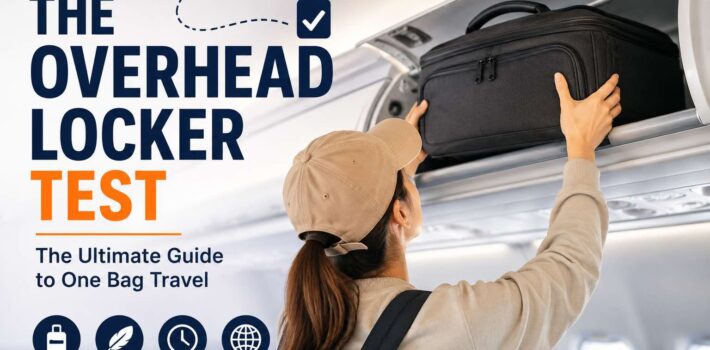
Imagine standing in front of a departure gate, watching the airline agents pull passenger after passenger out of line to check their oversized luggage. While they face hefty last-minute baggage fees and the looming dread of the airport carousel, you breeze straight past them with nothing but a single backpack. This isn’t just a travel luxury—it’s a masterclass in efficiency.
Few people understand this freedom better than Tony Wheeler, the legendary co-founder of Lonely Planet. With over 50 years of traversing the globe on his clock, Wheeler boils down his ultimate backpacking advice into one golden rule: Your bag must be small enough to easily lift over your head and fit straight into the overhead locker. If you can’t easily lift it, it is simply too heavy.
Passing the “Overhead Locker Test” doesn’t mean sacrificing what you need; it means packing smarter. Here is your definitive minimalist blueprint to surviving a 2-week trip using only an overhead cabin bag.
The Core Philosophy: Lightweight Layers & Versatile Gear
The secret to packing for two weeks in a single cabin bag is separating your wardrobe from a “one-outfit-per-day” mindset. Instead, you want to focus on high-quality, interchangeable layers. Your goal is to pack enough items for roughly 5 to 7 days, relying on a quick sink-wash or a local laundrette halfway through your trip.
- Embrace Merino Wool and Synthetics: Ditch heavy cotton t-shirts. Merino wool and high-grade synthetic fabrics are lightweight, naturally odor-resistant, and dry in a matter of hours if you wash them overnight.
- The 3-to-1 Rule: Pack three tops for every one bottom. Tops are what people notice, they take up less space, and they keep your outfits feeling fresh.
- Wear Your Heaviest Gear: Never pack your bulky boots, heaviest jacket, or thickest jumper. Wear them on the plane to instantly free up prime real estate inside your backpack.
The 2-Week One-Bag Packing Checklist
Stick strictly to this packing list, and your bag will comfortably pass any airline sizer or overhead test:
Clothing
- 5x Lightweight t-shirts or merino shirts
- 1x Smart-casual button-down shirt or blouse
- 2x Pairs of versatile trousers or shorts (neutral colors)
- 1x Lightweight mid-layer (fleece or thin sweater)
- 1x Packable waterproof rain jacket
- 5x Pairs of socks and underwear
- 1x Pair of comfortable walking shoes (worn on flight)
Toiletries & Electronics
- Solid Toiletries: Swap out liquid shampoos, conditioners, and soaps for solid bars. This completely bypasses liquid restrictions and prevents messy leaks.
- Universal Travel Adapter: One adapter with built-in USB slots to power all your devices at once.
- Tech Minimums: Leave the laptop at home unless you are working remotely. A smartphone and an e-reader are all you need.
Space-Saving Packing Hacks That Actually Work
How you arrange your gear matters just as much as what you bring. Stop folding your clothes traditionally—folding creates empty air pockets that waste crucial space. Instead, use the Ranger Roll technique. Rolling your clothes tightly compresses the fabric and makes it incredibly easy to stack items neatly.
To take organisation a step further, invest in a set of lightweight compression packing cubes. They act like vacuum seals for your wardrobe, segmenting your items and squeezing out excess air so your bag retains its compact shape.
Summary: Why Less Weight Equals Better Travel
As Tony Wheeler safely notes, a smaller bag changes how you experience a destination. You aren’t weighed down when walking through train stations, you aren’t paying extra baggage fees to low-cost airlines, and you can change your travel plans on a dime. Take the overhead locker test before your next flight—your back, your wallet, and your peace of mind will thank you.
Travelling by air soon? Don’t forget to book your airport drop off and pickup early at Travel Skyline for your peace of mind.
Flight Cancelled? The Secret Airline Rules Don’t Want You to Know
Flight Cancelled? The Secret Airline Rules They Don’t Want You to Know
Picture the scene: you’ve made it through airport security, grabbed a coffee, and found your gate. You look up at the departure board, waiting for the word Boarding to appear. Instead, the screen flashes bright red with a single word that instantly sinks your stomach: Cancelled.
Suddenly, the terminal erupts into quiet panic. People rush toward the service desk, phone batteries start draining, and travel plans dissolve into thin air. It’s a traveler’s ultimate nightmare, and it happens to thousands of passengers every single week. Just recently, a group of British school children on a trip to Barcelona found themselves abandoned overnight by their airline, forced to sleep on the hard terminal floor simply because the carrier claimed it couldn’t find hotel rooms for them.
When airport chaos strikes, most passengers make decisions out of sheer desperation. They accept useless vouchers, queue for hours in tears, or fork out hundreds of pounds of their own hard-earned money for replacement flights. Why? Because they don’t know their legal rights.
Airlines count on passenger ignorance to save themselves millions of pounds. But under UK and European consumer laws, you hold a massive shield. If your flight is hit by a major disruption, you aren’t at the mercy of the airline’s customer service lottery—you are legally entitled to specific care. Let’s break down exactly what you are owed under UK261 rules so you can handle your next flight meltdown like an absolute pro.
1. Refund vs. Rebooking: Your Legal Rights Under UK261
The moment an airline pulls the plug on your flight, the law kicks in to offer you an absolute choice. If your flight is covered by UK law (meaning you are departing from a UK airport on any airline, or arriving into the UK on a UK- or EU-regulated carrier), the airline cannot simply choose your fate for you. They must legally offer you two distinct paths, and the decision rests entirely in your hands.
Option A: The Full Cash Refund
If you decide to abandon your trip altogether because the delay has ruined the entire purpose of your travel, you have the right to a full cash refund. This must be paid back to you within seven days and covers the entire cost of the ticket for parts of the journey you didn’t get to take. If you are halfway through an itinerary (for instance, stuck at a connecting airport), they also owe you a free ticket back to your original departure point.
A Word of Warning on Vouchers: Airlines will almost always try to steer you toward an online travel voucher valid for 12 months. You do not have to accept this. If you want your cash back on your card, look them in the eye and state clearly that you are exercising your right to a full financial refund under UK261.
Option B: Alternative Rerouting (The “Secret” Weapon)
If you still need to get to your destination, you have the right to be rerouted at the “earliest opportunity.” This is where most airlines try to bend the rules to suit their own schedules. If an airline cancels your Friday morning flight, they will often try to automatically rebook you onto their next available flight—even if that flight isn’t until Sunday afternoon.
They will tell you, “We’ve put you on our next available seat, take it or leave it.” Do not accept this.
The Civil Aviation Authority (CAA) rules are incredibly strict on this point: if the airline cannot fly you out on the same day as your original ticket, and a rival airline can, your airline is legally obligated to buy you a seat on that competitor’s aircraft.
If British Airways or EasyJet cancels your flight, but Ryanair, Wizz Air, or even a premier carrier like Emirates has an open seat leaving that same afternoon, your airline must pay to put you on it. If they refuse, or their customer service phone lines are completely jammed, you have the right to buy that rival ticket yourself and claim every single penny back from the original airline.
2. What is the Airline’s “Duty of Care”?
When a flight is cancelled or heavily delayed, the airline has a legal obligation to look after you. This is known as their “Duty of Care.”
The most critical thing to know is that this right applies regardless of what caused the cancellation. Even if the flight was grounded by an “extraordinary circumstance” like freak weather or air traffic control strikes, the airline legally cannot abandon you at the terminal.
The airline must provide you with care and assistance until they can get you to your final destination. This includes:
- Food and Drink: Vouchers for refreshments relative to your waiting time (usually triggered after a 2-hour delay for short-haul flights).
- Communications: Reimbursement for essential phone calls or internet access to arrange alternative plans.
- Overnight Accommodation: A hotel room if your new replacement flight is the following day.
- Transport: Free transit between the airport and your temporary hotel accommodation (or your home, if you are able to travel back there).
3. The Golden Rules for DIY Expenses
During major airport disruptions, airline ground staff are often overwhelmed, or completely unavailable. If the airline fails to proactively hand out food vouchers or book you a hotel room, you have the right to organize it yourself and claim the money back later.
However, airlines will reject your claim if you treat the disruption like a lottery win. To ensure you actually get your money back, follow these strict rules:
Rule 1: Keep It “Reasonable”
The law protects necessary expenses, not luxury ones. Think clean, mid-range comfort, not five-star indulgence.
- Acceptable: A room at a Premier Inn, Holiday Inn, or a standard airport hotel. A normal dinner at an airport restaurant.
- Rejected: A luxury suite at the Ritz, expensive spa treatments, or bottles of premium alcohol.
Rule 2: Keep Every Single Receipt
A line on a credit card statement isn’t enough. You need the full, itemized tax receipts showing exactly what you bought, where, and at what time. Take a clear photo of every receipt on your phone immediately so you don’t lose the physical paper copy in transit.
Rule 3: Only Transport via Public Links
If the airline doesn’t provide a shuttle to the hotel, public transport or a standard local taxi is perfectly acceptable to claim back. Avoid ordering premium or luxury ride shares unless it is the absolute only option available, and keep the digital invoice.
Rule 4: Hold Out for the Alternative Flight
If you choose to take a full refund for your ticket instead of letting the airline rebook you on the next available flight, their Duty of Care officially ends. Once you take the cash refund, you are on your own for any further hotel or food costs.
4. Flight Cancellation Compensation: Can You Claim Cash?
Beyond food, drink, and hotels, you might also be entitled to cold, hard cash compensation of up to £520 per person. However, this is where the cause of the cancellation matters immensely.
To qualify for a cash payout, your situation must meet two criteria:
- The cancellation happened less than 14 days before your scheduled departure date.
- The root cause was within the airline’s control (e.g., airline staff shortages, technical airplane faults, or crew running out of legal working hours).
If your flight was cancelled due to a severe thunderstorm or an air traffic control system failure, it is classified as an “extraordinary circumstance,” meaning the airline doesn’t owe you cash compensation—though they still owe you the Duty of Care items mentioned above.
| Flight Distance | Typical Destinations | Compensation Amount |
|---|---|---|
| Short-haul (Under 1,500 km) | London to Paris, Amsterdam, Barcelona | £220 per person |
| Medium-haul (1,500 km – 3,500 km) | London to Tenerife, Athens, Istanbul | £350 per person |
| Long-haul (Over 3,500 km) | London to New York, Dubai, Nairobi | £520 per person |
5. Your Gate-Side Emergency Checklist
If you’re standing at the terminal right now looking at a cancelled flight, bookmark this page and complete these four steps immediately:
- Get the paperwork: Ask ground staff for a physical copy of their passenger rights leaflet. They are legally required to provide it.
- Check rival airlines: Open a flight aggregator app. If there is a flight out today on a competitor airline, demand that your carrier rebook you on it.
- Document the breakdown: If the airline’s app crashes or customer service desks are empty, take screenshots or photos. This is your proof that you had to take matters into your own hands.
- File your claim fast: Don’t wait. Collect your itemized receipts and file your expense and compensation claim directly via the airline’s web portal as soon as you get home.
Don’t forget to book your airport dropoff and pickup early for peace of mind with https://travelskyline.co.uk/airport-dropoff/

